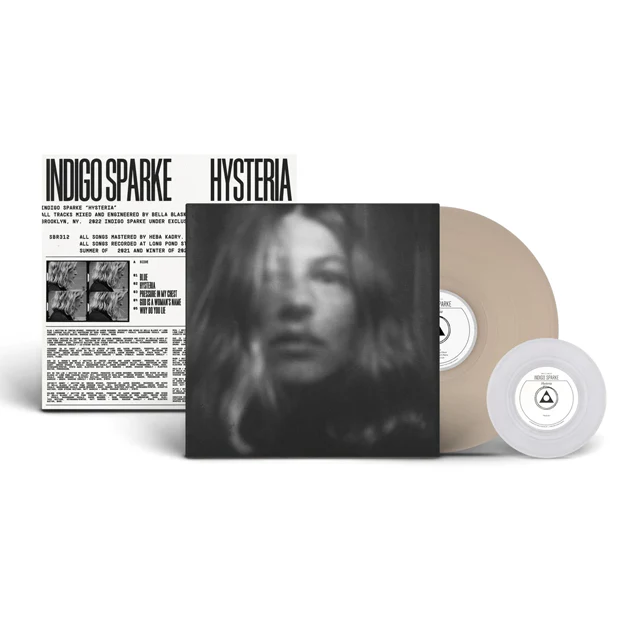
Hysteria: Cloudy Clear Vinyl LP + Clear 7"
“To be at the edge, at the precipice of anything, requires deep surrender. It’s like dying over and over again. In the tidal throes of life at its fullest and most intense is the space where grace and strength is fortified and cultivated, is what I am learning” Indigo Sparke ruminates on her magnetic second full-length album Hysteria, a huge and beautiful sweeping work, one that possesses a rare, reflective power. From the first few notes, in the first song, Blue, something chilling and captivating pierces straight into the listener’s chest. With harmonies reminiscent of the voices in our heads, she examines love, loss, grief, a newly realized rage, her history, dreams, and the emotional weather patterns surrounding those sensations: her words tell the stories, and the sounds act them out. It’s a diary built for big stages. ‘Hysteria’ arrives just a year after her striking, minimalist debut, Echo. Here though, Sparke offers an expansive body of work—it’s a simultaneously nostalgic yet clear and complex collection that expands her sound and outlook.
Work on the record began at the start of the COVID-19 pandemic while Sparke was stranded in quarantine in her native Australia waiting for her visa to be renewed so she could return to the States. Echo was being prepared for release, but Sparke was already experiencing a flow of creative thought as a result of shifts in her own life. “I was going through an intense separation and processing all of that in the deep flux of the world collapsing,” she recalls. “I was moving through huge waves of grief and trying to reconcile what was going on, internally and externally. The grief opened a doorway to the past I thought I had made peace with. But there were days where I just couldn’t get off the floor. It felt like everything was falling through this hole in my chest. It felt stark and nauseating to feel such immense groundlessness whilst also looking at all the different versions of myself I had been. All the varied different chapters I had experienced, from heavy drug use, to sexual abuse, love in all its forms, complex trauma and mental health, time spent living in India and Bali seeking something deeper to make sense of it all. It was almost like my life was flashing before my eyes. I realized I was in a profound altered state, as everything simultaneously stood still around me yet was flashing violently inside of me.”
After moving back to New York in the spring of 2021, Sparke finished writing the album’s 14 songs and decamped upstate with producer Aaron Dessner (The National, Taylor Swift). “I just had a really strong intuitive gut feeling that I would do this album with Aaron. We had met once years before in Eau Claire so I asked my manager to reach out to him. When we first talked, we talked about co-writing from scratch, I did have a big folder of demos but was nervous to share them, but after he heard them he said, ‘There’s so much to work with in here already,’” Sparke recalls on how Dessner, who also contributes instrumentation along with multi-instrumentalist and long time collaborator Shahzad Ismaily and drummer Matt Barrick (The Walkmen, Muzz), got involved in bringing Hysteria to life. “Aaron is such an incredible person, to feel his generosity and to feel him in my corner is a true gift. It definitely took a moment for me to get used to a different way of working and hand my trust and heart over to him and his vision but it also felt so natural and we became close friends in the process.”
The connection felt intuitive for both Sparke and Dessner who recalls “I started hearing ideas listening to her voice almost immediately. We connected by phone and had a long talk. She was incredibly open and gracious and really it was creatively inspiring from the moment we started working. It always feels like some weird miracle when songs emerge that you want to listen to all the time -- and this was definitely the case with her record. It feels cohesive and timeless and inspired to me in a way that I know I will keep coming back to. I think the chemistry is right.” Centering Sparke’s powerful vocals throughout, Hysteria is packed with big guitars and layered instrumentation that practically acts as the album’s lungs, giving every note breath. If Echo bore the mark of producer Adrianne Lenker’s intimate, spectral approach, then Hysteria is comparatively full-bodied and warm like a raging fire, as Dessner’s ornate instrumentation perfectly compliment Sparke’s songwriting. The result is music that sounds timeless.
This is music that sounds huge even as it zooms in on the trials and turmoils of one’s inner life, from the pulsing immediacy of “Infinity Honey” to the soaring “God Is a Woman’s Name” or the towering chorus on “Hold On.” You can hear Sparke reflecting on reconciliation, grief, hope, and the passage of time on the perpetually building “Pressure in My Chest” and the airy, Joni Mitchell-esque title track, which finds her embracing a gorgeous upper register over gently strummed guitar. “Set Your Fire on Me” builds and bursts not unlike Angel Olsen’s own raw folk-rock expressionism—and then there’s the stark opener and first single “Blue,” which acts as a cosmic road map for Sparke’s own journey in life. “It was very stream-of-consciousness—it just came out in one go,” she says while discussing how the song came together. “It’s almost like a biopic, or my own version of The Odyssey, charting what I’d been going through while traveling through the realms of time. Being in the movement of grief, memory, and love was intense and beautiful for me, because I didn’t feel stagnant—so the song has a galloping sense of expression as a result. It doesn’t let up.” While reflecting on the album’s thematic bent Sparke observes “My mum pointed out how often I use the word ‘blue,’ which is kind of ironic because that’s what my name means.” There’s all the shades of what blue could be, emotionally, and tonally throughout the record.
To Sparke, Hysteria is reflective of the growth she’s experienced over the last many years—to the point where, in her words, it almost presents a different artistic perspective entirely. “I feel like I matured a lot in this epoch of expression,” she explains. “When you are alone in the dark, you see yourself more clearly. I realized a lot of my behavior and patterns living at edge states. The edge of hope, sorrow, joy, etc. I was at the axis point inside of love right at the edge of a place that had been a home of hysteria for me in the past. Since this reckoning I’ve been determined to find a sense of surrender in the chaos. An unwavering trust and faith. And a will to remain kind and calm and patient with myself so that I can move towards embodying grace more and more. It’s the only way to survive for me now. So there’s a deeper acceptance of who I am and what’s made me, me. I think in the process of all of this somewhere along the road I quietly became a woman and now I don’t feel as fragile as I once did, or now, I accept the wild inner landscape of myself and my history and it gives me a different kind of strength to work from.”
While the world that Sparke inhabits is a rich tapestry of sound that pulls the listener into circular spaces of seemingly never ending minimalistic textures and harmonic suspensions, what’s most clearly on display is her voice and her song forms. Deceptively simple structures wind like labyrinths in a whirlwind of lyrical expression and vocal pageantry calling to mind the early works of PJ Harvey, Meredith Monk, and the like. These compositions are a warm invitation into her world
“To be at the edge, at the precipice of anything, requires deep surrender. It’s like dying over and over again. In the tidal throes of life at its fullest and most intense is the space where grace and strength is fortified and cultivated, is what I am learning” Indigo Sparke ruminates on her magnetic second full-length album Hysteria, a huge and beautiful sweeping work, one that possesses a rare, reflective power. From the first few notes, in the first song, Blue, something chilling and captivating pierces straight into the listener’s chest. With harmonies reminiscent of the voices in our heads, she examines love, loss, grief, a newly realized rage, her history, dreams, and the emotional weather patterns surrounding those sensations: her words tell the stories, and the sounds act them out. It’s a diary built for big stages. ‘Hysteria’ arrives just a year after her striking, minimalist debut, Echo. Here though, Sparke offers an expansive body of work—it’s a simultaneously nostalgic yet clear and complex collection that expands her sound and outlook.
Work on the record began at the start of the COVID-19 pandemic while Sparke was stranded in quarantine in her native Australia waiting for her visa to be renewed so she could return to the States. Echo was being prepared for release, but Sparke was already experiencing a flow of creative thought as a result of shifts in her own life. “I was going through an intense separation and processing all of that in the deep flux of the world collapsing,” she recalls. “I was moving through huge waves of grief and trying to reconcile what was going on, internally and externally. The grief opened a doorway to the past I thought I had made peace with. But there were days where I just couldn’t get off the floor. It felt like everything was falling through this hole in my chest. It felt stark and nauseating to feel such immense groundlessness whilst also looking at all the different versions of myself I had been. All the varied different chapters I had experienced, from heavy drug use, to sexual abuse, love in all its forms, complex trauma and mental health, time spent living in India and Bali seeking something deeper to make sense of it all. It was almost like my life was flashing before my eyes. I realized I was in a profound altered state, as everything simultaneously stood still around me yet was flashing violently inside of me.”
After moving back to New York in the spring of 2021, Sparke finished writing the album’s 14 songs and decamped upstate with producer Aaron Dessner (The National, Taylor Swift). “I just had a really strong intuitive gut feeling that I would do this album with Aaron. We had met once years before in Eau Claire so I asked my manager to reach out to him. When we first talked, we talked about co-writing from scratch, I did have a big folder of demos but was nervous to share them, but after he heard them he said, ‘There’s so much to work with in here already,’” Sparke recalls on how Dessner, who also contributes instrumentation along with multi-instrumentalist and long time collaborator Shahzad Ismaily and drummer Matt Barrick (The Walkmen, Muzz), got involved in bringing Hysteria to life. “Aaron is such an incredible person, to feel his generosity and to feel him in my corner is a true gift. It definitely took a moment for me to get used to a different way of working and hand my trust and heart over to him and his vision but it also felt so natural and we became close friends in the process.”
The connection felt intuitive for both Sparke and Dessner who recalls “I started hearing ideas listening to her voice almost immediately. We connected by phone and had a long talk. She was incredibly open and gracious and really it was creatively inspiring from the moment we started working. It always feels like some weird miracle when songs emerge that you want to listen to all the time -- and this was definitely the case with her record. It feels cohesive and timeless and inspired to me in a way that I know I will keep coming back to. I think the chemistry is right.” Centering Sparke’s powerful vocals throughout, Hysteria is packed with big guitars and layered instrumentation that practically acts as the album’s lungs, giving every note breath. If Echo bore the mark of producer Adrianne Lenker’s intimate, spectral approach, then Hysteria is comparatively full-bodied and warm like a raging fire, as Dessner’s ornate instrumentation perfectly compliment Sparke’s songwriting. The result is music that sounds timeless.
This is music that sounds huge even as it zooms in on the trials and turmoils of one’s inner life, from the pulsing immediacy of “Infinity Honey” to the soaring “God Is a Woman’s Name” or the towering chorus on “Hold On.” You can hear Sparke reflecting on reconciliation, grief, hope, and the passage of time on the perpetually building “Pressure in My Chest” and the airy, Joni Mitchell-esque title track, which finds her embracing a gorgeous upper register over gently strummed guitar. “Set Your Fire on Me” builds and bursts not unlike Angel Olsen’s own raw folk-rock expressionism—and then there’s the stark opener and first single “Blue,” which acts as a cosmic road map for Sparke’s own journey in life. “It was very stream-of-consciousness—it just came out in one go,” she says while discussing how the song came together. “It’s almost like a biopic, or my own version of The Odyssey, charting what I’d been going through while traveling through the realms of time. Being in the movement of grief, memory, and love was intense and beautiful for me, because I didn’t feel stagnant—so the song has a galloping sense of expression as a result. It doesn’t let up.” While reflecting on the album’s thematic bent Sparke observes “My mum pointed out how often I use the word ‘blue,’ which is kind of ironic because that’s what my name means.” There’s all the shades of what blue could be, emotionally, and tonally throughout the record.
To Sparke, Hysteria is reflective of the growth she’s experienced over the last many years—to the point where, in her words, it almost presents a different artistic perspective entirely. “I feel like I matured a lot in this epoch of expression,” she explains. “When you are alone in the dark, you see yourself more clearly. I realized a lot of my behavior and patterns living at edge states. The edge of hope, sorrow, joy, etc. I was at the axis point inside of love right at the edge of a place that had been a home of hysteria for me in the past. Since this reckoning I’ve been determined to find a sense of surrender in the chaos. An unwavering trust and faith. And a will to remain kind and calm and patient with myself so that I can move towards embodying grace more and more. It’s the only way to survive for me now. So there’s a deeper acceptance of who I am and what’s made me, me. I think in the process of all of this somewhere along the road I quietly became a woman and now I don’t feel as fragile as I once did, or now, I accept the wild inner landscape of myself and my history and it gives me a different kind of strength to work from.”
While the world that Sparke inhabits is a rich tapestry of sound that pulls the listener into circular spaces of seemingly never ending minimalistic textures and harmonic suspensions, what’s most clearly on display is her voice and her song forms. Deceptively simple structures wind like labyrinths in a whirlwind of lyrical expression and vocal pageantry calling to mind the early works of PJ Harvey, Meredith Monk, and the like. These compositions are a warm invitation into her world
Description
“To be at the edge, at the precipice of anything, requires deep surrender. It’s like dying over and over again. In the tidal throes of life at its fullest and most intense is the space where grace and strength is fortified and cultivated, is what I am learning” Indigo Sparke ruminates on her magnetic second full-length album Hysteria, a huge and beautiful sweeping work, one that possesses a rare, reflective power. From the first few notes, in the first song, Blue, something chilling and captivating pierces straight into the listener’s chest. With harmonies reminiscent of the voices in our heads, she examines love, loss, grief, a newly realized rage, her history, dreams, and the emotional weather patterns surrounding those sensations: her words tell the stories, and the sounds act them out. It’s a diary built for big stages. ‘Hysteria’ arrives just a year after her striking, minimalist debut, Echo. Here though, Sparke offers an expansive body of work—it’s a simultaneously nostalgic yet clear and complex collection that expands her sound and outlook.
Work on the record began at the start of the COVID-19 pandemic while Sparke was stranded in quarantine in her native Australia waiting for her visa to be renewed so she could return to the States. Echo was being prepared for release, but Sparke was already experiencing a flow of creative thought as a result of shifts in her own life. “I was going through an intense separation and processing all of that in the deep flux of the world collapsing,” she recalls. “I was moving through huge waves of grief and trying to reconcile what was going on, internally and externally. The grief opened a doorway to the past I thought I had made peace with. But there were days where I just couldn’t get off the floor. It felt like everything was falling through this hole in my chest. It felt stark and nauseating to feel such immense groundlessness whilst also looking at all the different versions of myself I had been. All the varied different chapters I had experienced, from heavy drug use, to sexual abuse, love in all its forms, complex trauma and mental health, time spent living in India and Bali seeking something deeper to make sense of it all. It was almost like my life was flashing before my eyes. I realized I was in a profound altered state, as everything simultaneously stood still around me yet was flashing violently inside of me.”
After moving back to New York in the spring of 2021, Sparke finished writing the album’s 14 songs and decamped upstate with producer Aaron Dessner (The National, Taylor Swift). “I just had a really strong intuitive gut feeling that I would do this album with Aaron. We had met once years before in Eau Claire so I asked my manager to reach out to him. When we first talked, we talked about co-writing from scratch, I did have a big folder of demos but was nervous to share them, but after he heard them he said, ‘There’s so much to work with in here already,’” Sparke recalls on how Dessner, who also contributes instrumentation along with multi-instrumentalist and long time collaborator Shahzad Ismaily and drummer Matt Barrick (The Walkmen, Muzz), got involved in bringing Hysteria to life. “Aaron is such an incredible person, to feel his generosity and to feel him in my corner is a true gift. It definitely took a moment for me to get used to a different way of working and hand my trust and heart over to him and his vision but it also felt so natural and we became close friends in the process.”
The connection felt intuitive for both Sparke and Dessner who recalls “I started hearing ideas listening to her voice almost immediately. We connected by phone and had a long talk. She was incredibly open and gracious and really it was creatively inspiring from the moment we started working. It always feels like some weird miracle when songs emerge that you want to listen to all the time -- and this was definitely the case with her record. It feels cohesive and timeless and inspired to me in a way that I know I will keep coming back to. I think the chemistry is right.” Centering Sparke’s powerful vocals throughout, Hysteria is packed with big guitars and layered instrumentation that practically acts as the album’s lungs, giving every note breath. If Echo bore the mark of producer Adrianne Lenker’s intimate, spectral approach, then Hysteria is comparatively full-bodied and warm like a raging fire, as Dessner’s ornate instrumentation perfectly compliment Sparke’s songwriting. The result is music that sounds timeless.
This is music that sounds huge even as it zooms in on the trials and turmoils of one’s inner life, from the pulsing immediacy of “Infinity Honey” to the soaring “God Is a Woman’s Name” or the towering chorus on “Hold On.” You can hear Sparke reflecting on reconciliation, grief, hope, and the passage of time on the perpetually building “Pressure in My Chest” and the airy, Joni Mitchell-esque title track, which finds her embracing a gorgeous upper register over gently strummed guitar. “Set Your Fire on Me” builds and bursts not unlike Angel Olsen’s own raw folk-rock expressionism—and then there’s the stark opener and first single “Blue,” which acts as a cosmic road map for Sparke’s own journey in life. “It was very stream-of-consciousness—it just came out in one go,” she says while discussing how the song came together. “It’s almost like a biopic, or my own version of The Odyssey, charting what I’d been going through while traveling through the realms of time. Being in the movement of grief, memory, and love was intense and beautiful for me, because I didn’t feel stagnant—so the song has a galloping sense of expression as a result. It doesn’t let up.” While reflecting on the album’s thematic bent Sparke observes “My mum pointed out how often I use the word ‘blue,’ which is kind of ironic because that’s what my name means.” There’s all the shades of what blue could be, emotionally, and tonally throughout the record.
To Sparke, Hysteria is reflective of the growth she’s experienced over the last many years—to the point where, in her words, it almost presents a different artistic perspective entirely. “I feel like I matured a lot in this epoch of expression,” she explains. “When you are alone in the dark, you see yourself more clearly. I realized a lot of my behavior and patterns living at edge states. The edge of hope, sorrow, joy, etc. I was at the axis point inside of love right at the edge of a place that had been a home of hysteria for me in the past. Since this reckoning I’ve been determined to find a sense of surrender in the chaos. An unwavering trust and faith. And a will to remain kind and calm and patient with myself so that I can move towards embodying grace more and more. It’s the only way to survive for me now. So there’s a deeper acceptance of who I am and what’s made me, me. I think in the process of all of this somewhere along the road I quietly became a woman and now I don’t feel as fragile as I once did, or now, I accept the wild inner landscape of myself and my history and it gives me a different kind of strength to work from.”
While the world that Sparke inhabits is a rich tapestry of sound that pulls the listener into circular spaces of seemingly never ending minimalistic textures and harmonic suspensions, what’s most clearly on display is her voice and her song forms. Deceptively simple structures wind like labyrinths in a whirlwind of lyrical expression and vocal pageantry calling to mind the early works of PJ Harvey, Meredith Monk, and the like. These compositions are a warm invitation into her world